 6:46Prophet Ibrahim (AS) Story Ep 14 | Building the Kaaba
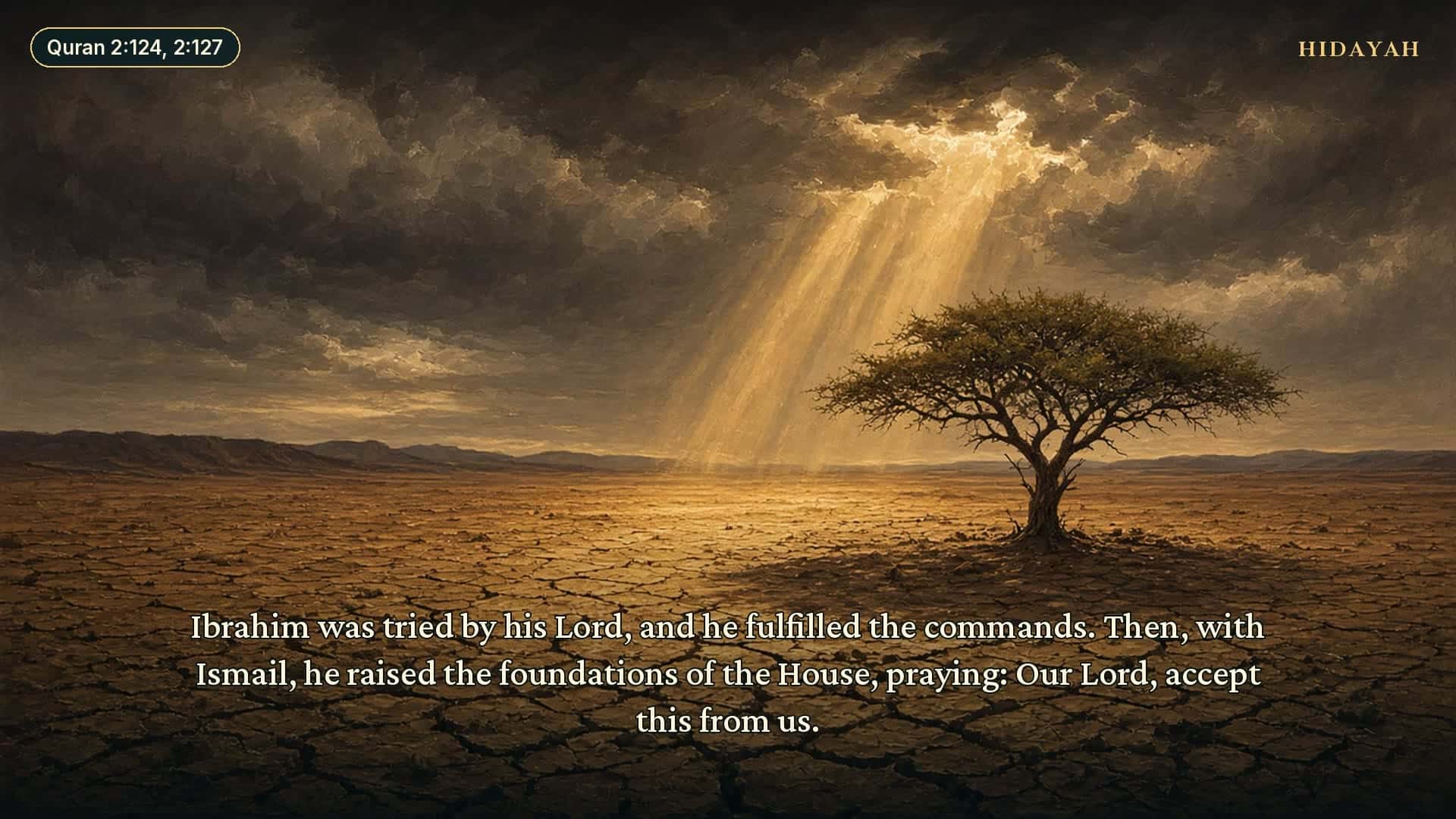
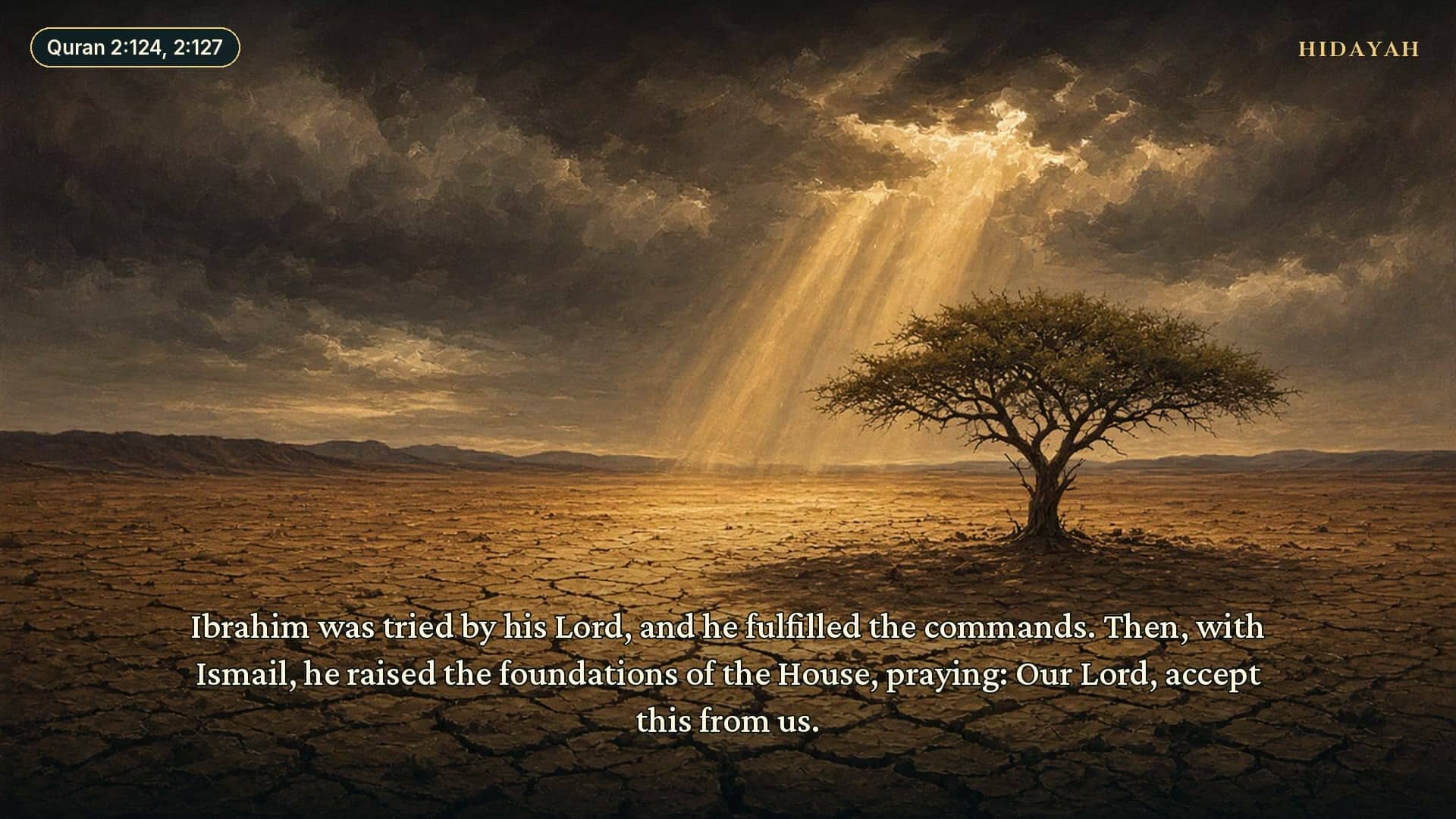
Ibrahim was tried by his Lord, and he fulfilled the commands. Then, with Ismail, he raised the foundations of the House, praying: Our Lord, accept this from us. Follow the story of Prophet Ibrahim (Abraham), peace be upon him, in Episode 14: Building the Kaaba.
This Quran-only episode follows Surah Al-Baqarah 2:124–129 and Surah Ibrahim 14:35–41: the trial, "Indeed, I will make you a leader for the people"; his question, "And of my descendants?"; the answer, "My covenant does not include the wrongdoers"; the House made "a place of return for the people and [a place of] security"; the charge, "Purify My House"; his prayer for "a secure city"; the building itself, "when Abraham was raising the foundations of the House and [with him] Ishmael"; their prayer, "Our Lord, accept [this] from us. Indeed, You are the Hearing, the Knowing"; "make us Muslims [in submission] to You"; "send among them a messenger from themselves"; and the prayers of Surah Ibrahim, "I have settled some of my descendants in an uncultivated valley near Your sacred House" and "Praise to Allāh, who has granted to me in old age Ishmael and Isaac." Ishmael and Isaac are named only because the verses name them. No names or details are added beyond those in the verses, and none are invented. Later events belong to other passages and other episodes.
Every on-screen quotation is an exact excerpt of the Saheeh International translation with its verse reference. Arabic cards use Uthmani Quran text.
Visuals and voices made with AI assistance.
#Hidayah #ProphetStories #IslamicStories #Quran00
 6:12Prophet Ibrahim (AS) Story Ep 13 | The Sacrifice
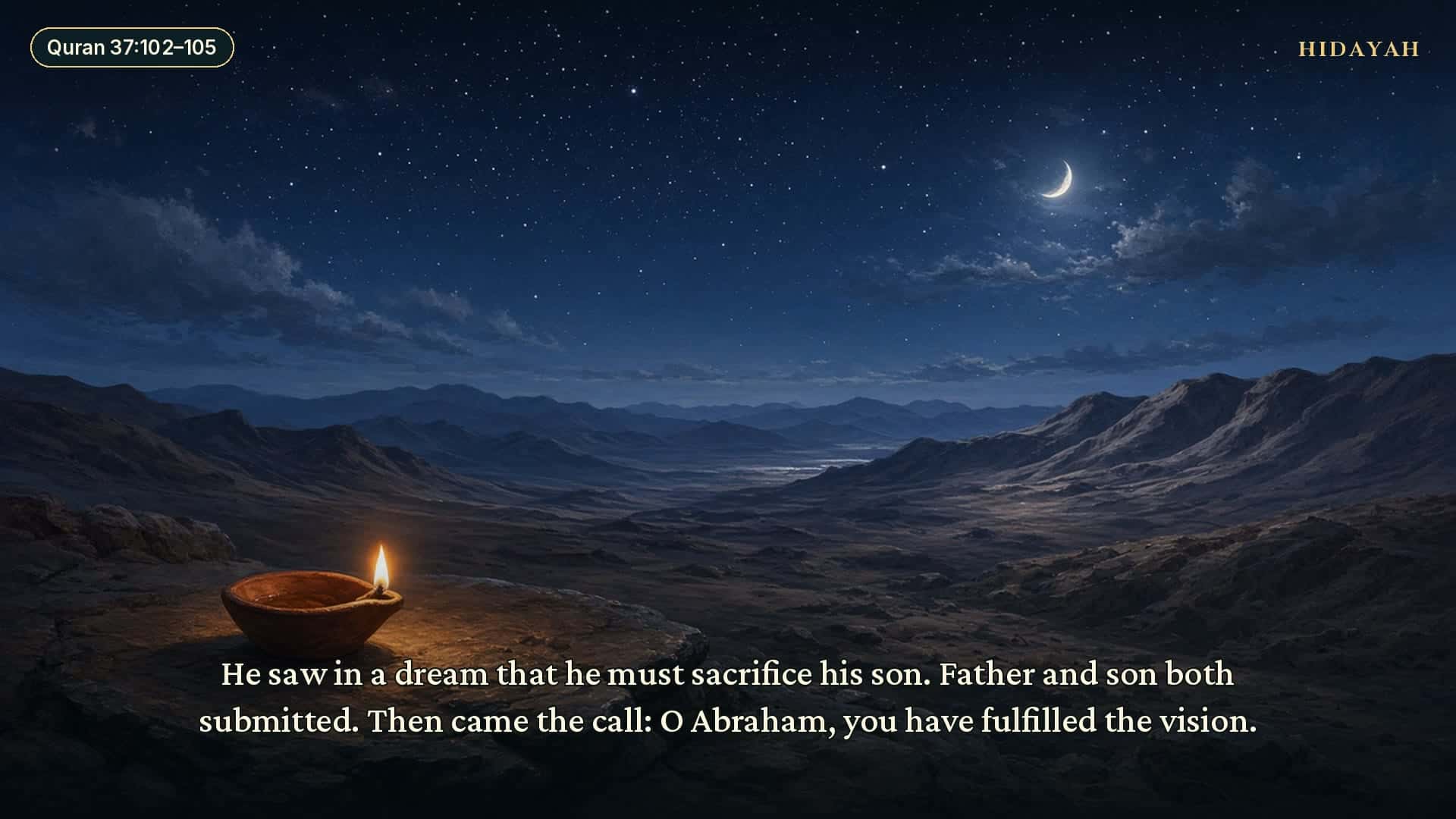
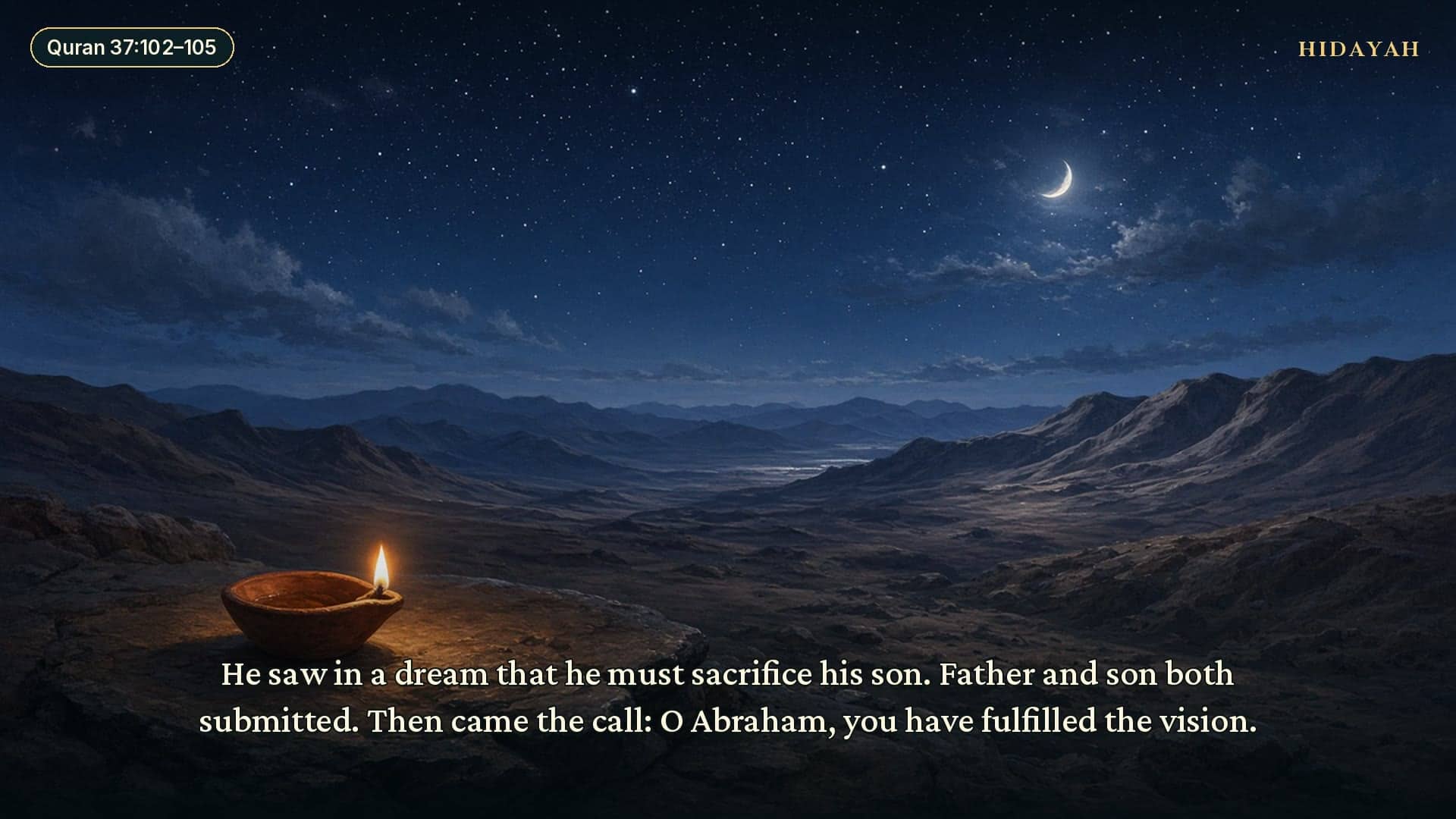
He saw in a dream that he must sacrifice his son. Father and son both submitted. Then came the call: O Abraham, you have fulfilled the vision. Follow the story of Prophet Ibrahim (Abraham), peace be upon him, in Episode 13: The Sacrifice.
This Quran-only episode follows Surah As-Saffat 37:99–113: his words, "Indeed, I will go to [where I am ordered by] my Lord; He will guide me"; his prayer, "My Lord, grant me [a child] from among the righteous"; the good tidings of a forbearing boy; the dream, "O my son, indeed I have seen in a dream that I [must] sacrifice you, so see what you think"; the answer of the son, "O my father, do as you are commanded. You will find me, if Allāh wills, of the steadfast"; the moment they both submitted; the call, "O Abraham, You have fulfilled the vision"; "Indeed, this was the clear trial"; "And We ransomed him with a great sacrifice"; "Peace upon Abraham"; and the good tidings and blessing that close the passage. The verses do not name the son, and this episode does not name him. No names or details are added beyond those in the verses, and none are invented. Later events belong to other passages and other episodes.
Every on-screen quotation is an exact excerpt of the Saheeh International translation with its verse reference. Arabic cards use Uthmani Quran text. Narration uses Ibrahim; the translation writes Abraham. Spoken quotations omit bracket notation and explanatory [i.e., ...] glosses, while captions preserve the source wording.
Visuals and voices made with AI assistance.
#Hidayah #ProphetStories #IslamicStories #Quran00
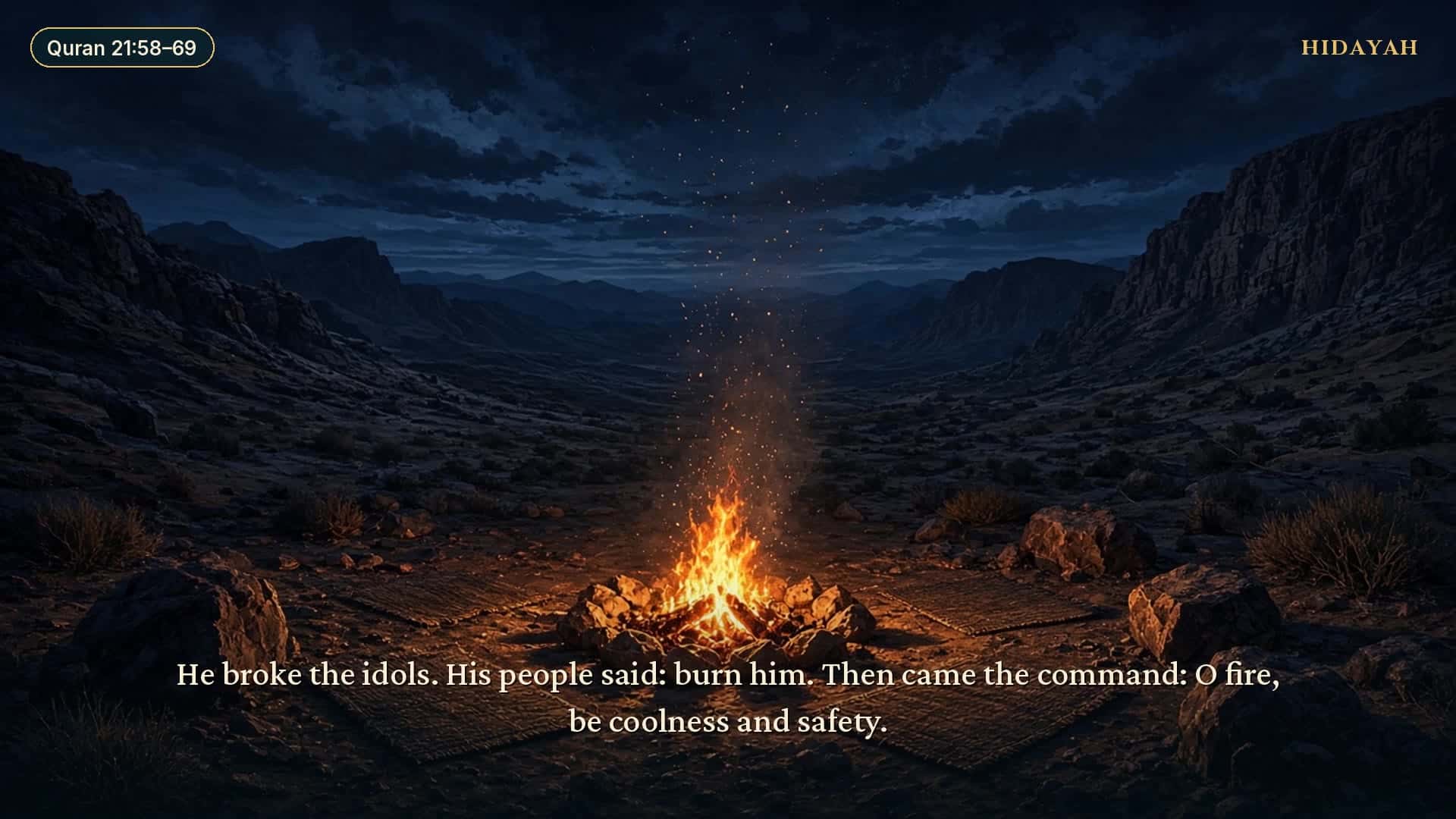
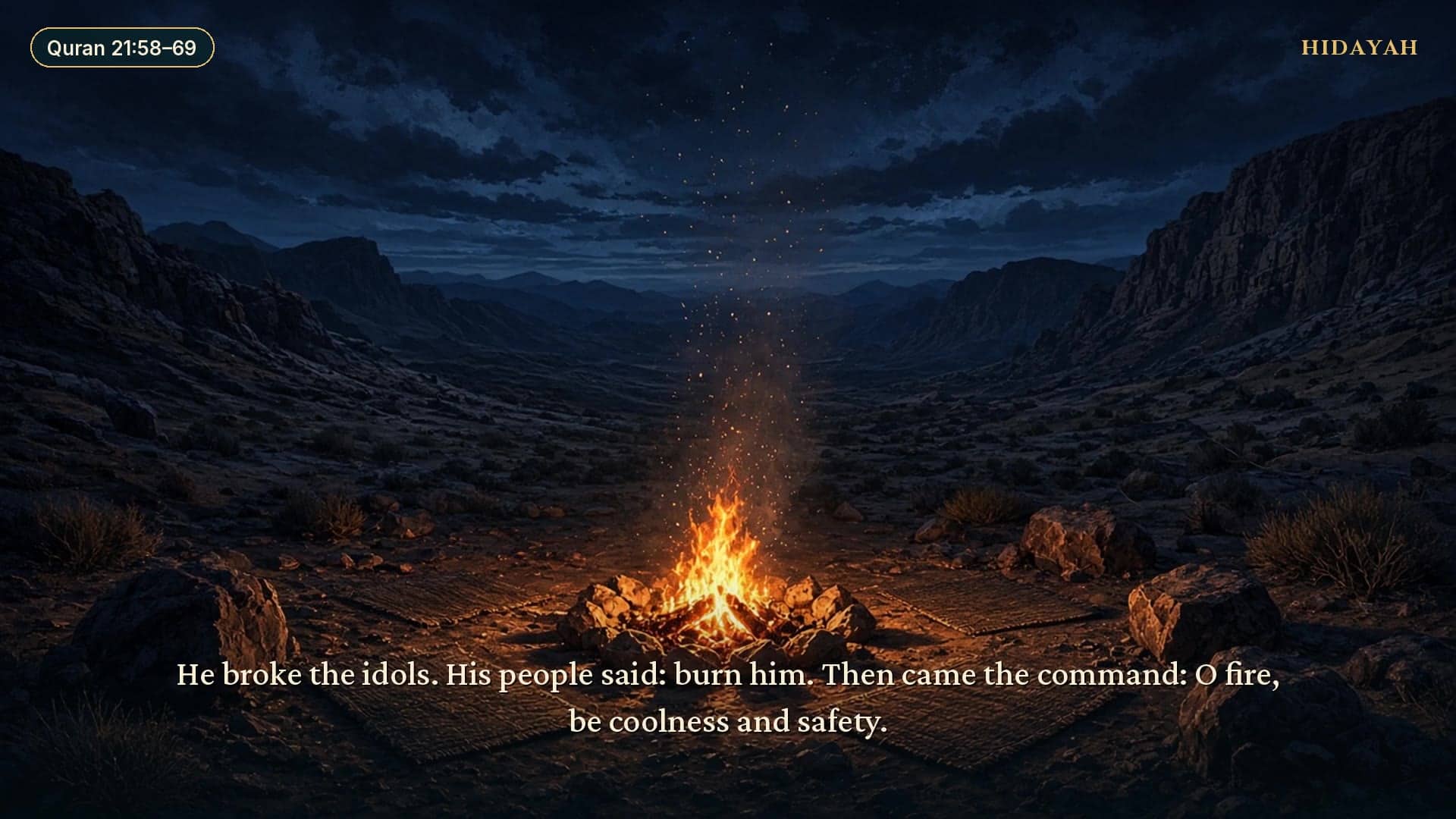 6:26Prophet Ibrahim (AS) Story Ep 12 | The Fire Became Cool
He broke the idols, and his people said: Burn him. Then Allah said: O fire, be coolness and safety upon Abraham. Follow the story of Prophet Ibrahim (Abraham), peace be upon him, in Episode 12: The Fire Became Cool.
This Quran-only episode follows Surah Al-Anbiya 21:51–70, with Surah As-Saffat 37:83–98 and Surah Al-Ankabut 29:24: the sound judgement given to Ibrahim and the sound heart with which he came to his Lord; his question to his father and his people, "What are these statues to which you are devoted?"; his plan against the idols; the idols made into fragments except a large one; the question of his people, "Have you done this to our gods, O Abraham?"; his answer, "so ask them, if they should [be able to] speak"; his question, "Then will you not use reason?"; the command of his people, "Burn him and support your gods"; the command of Allah, "O fire, be coolness and safety upon Abraham"; and the end of their plan, "but We made them the greatest losers." No names are added beyond those in the verses, and none are invented. Later events belong to other passages and other episodes.
Every on-screen quotation is an exact excerpt of the Saheeh International translation with its verse reference. Arabic cards use Uthmani Quran text. Narration uses Ibrahim; the translation writes Abraham. Spoken quotations omit bracket notation and explanatory [i.e., ...] glosses, while captions preserve the source wording.
Visuals and voices made with AI assistance.
#Hidayah #ProphetStories #IslamicStories #Quran00
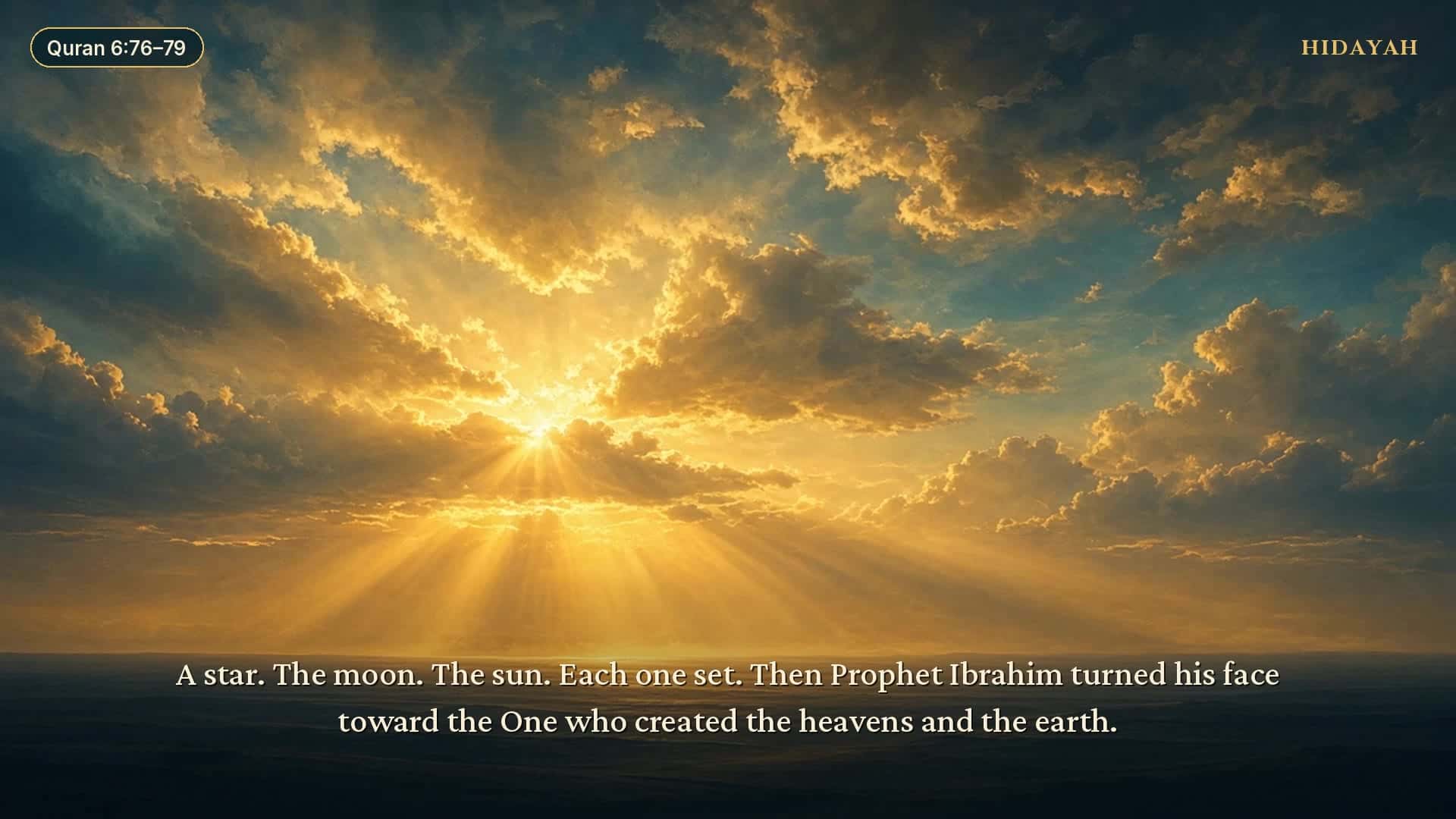
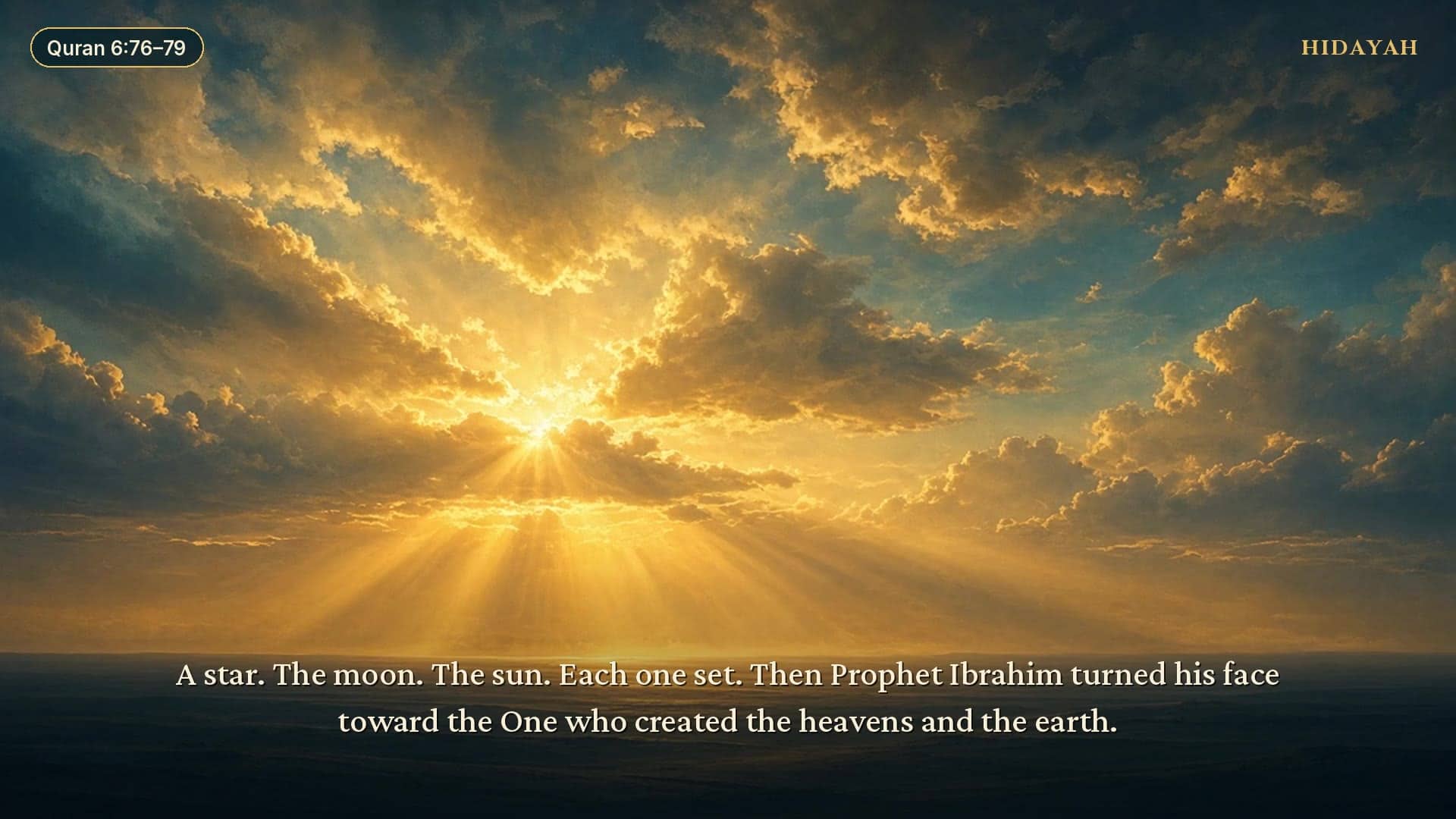 6:55Prophet Ibrahim (AS) Story Ep 11 | Searching for Truth
He saw a star. He saw the moon. He saw the sun. Each one set, and then he said: Indeed, I have turned my face toward He who created the heavens and the earth. Follow the story of Prophet Ibrahim (Abraham), peace be upon him, in Episode 11: Searching for the Truth.
This Quran-only episode follows Surah Al-An'am 6:74–83, Surah Maryam 19:41–48 and Surah Al-Anbiya 21:52–56: the question to his father about idols; the realm of the heavens and the earth shown to Ibrahim; the star, the moon and the sun that set; his words to his people, "O my people, indeed I am free from what you associate with Allah"; the argument of his people and his question about which of the two parties has more right to security; his gentle words to his father in Surah Maryam, including "Peace will be upon you"; and his question to his father and his people in Surah Al-Anbiya, "What are these statues to which you are devoted?" The Quran does not add names beyond those in the verses (the verses name his father as Azar), and none are invented. Later events belong to other passages and other episodes.
Every on-screen quotation is an exact excerpt of the Saheeh International translation with its verse reference. Arabic cards use Uthmani Quran text. Narration uses Ibrahim; the translation writes Abraham. Spoken quotations omit bracket notation and explanatory [i.e., ...] glosses, while captions preserve the source wording. No hadith, israiliyyat, invented names or invented conversations are used.
Chapters
Visuals and voices made with AI assistance.
#Hidayah #ProphetStories #IslamicStories #Quran00
 6:05Prophet Musa (AS) Story Ep 10 | The Sea Parts
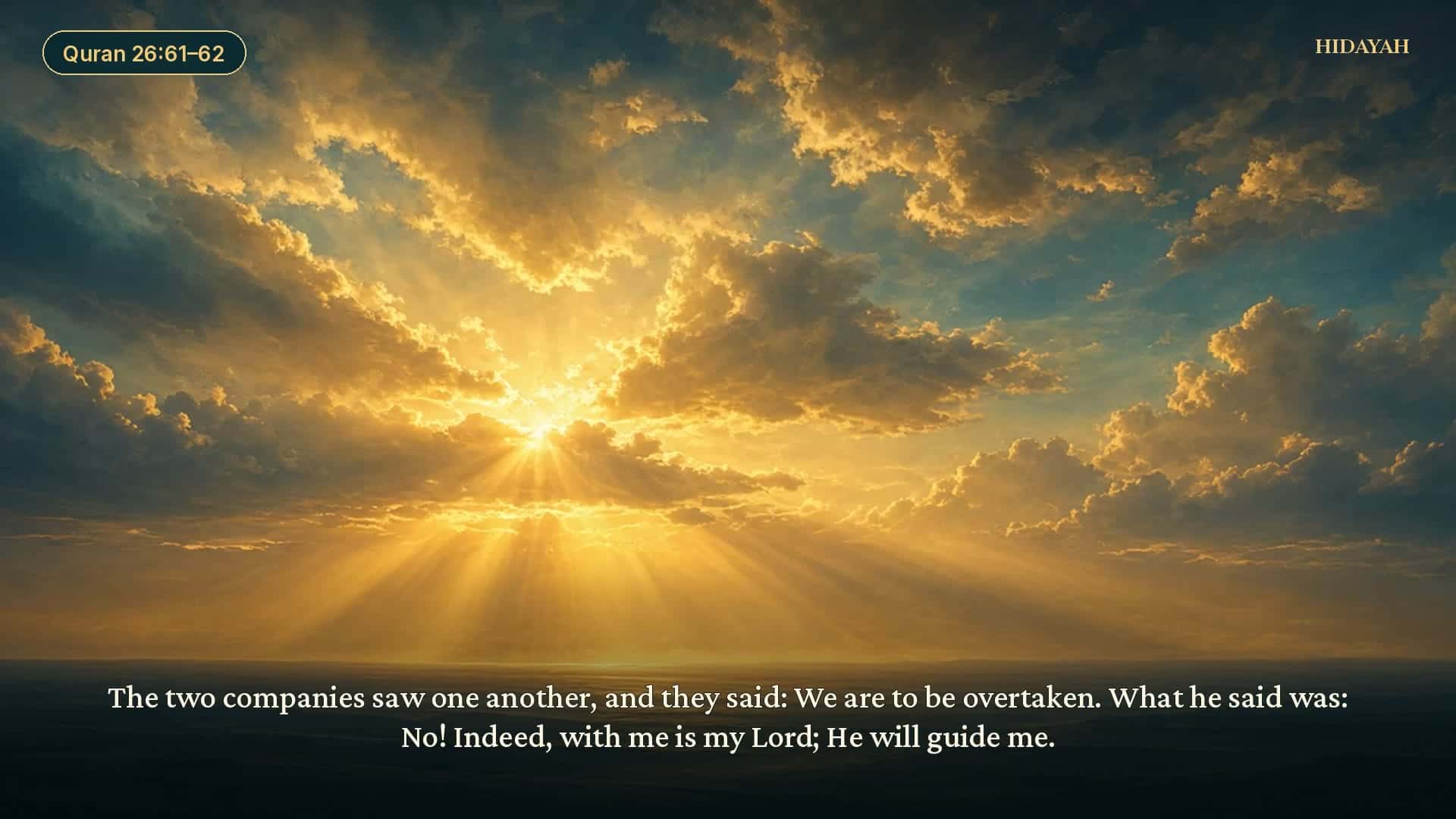
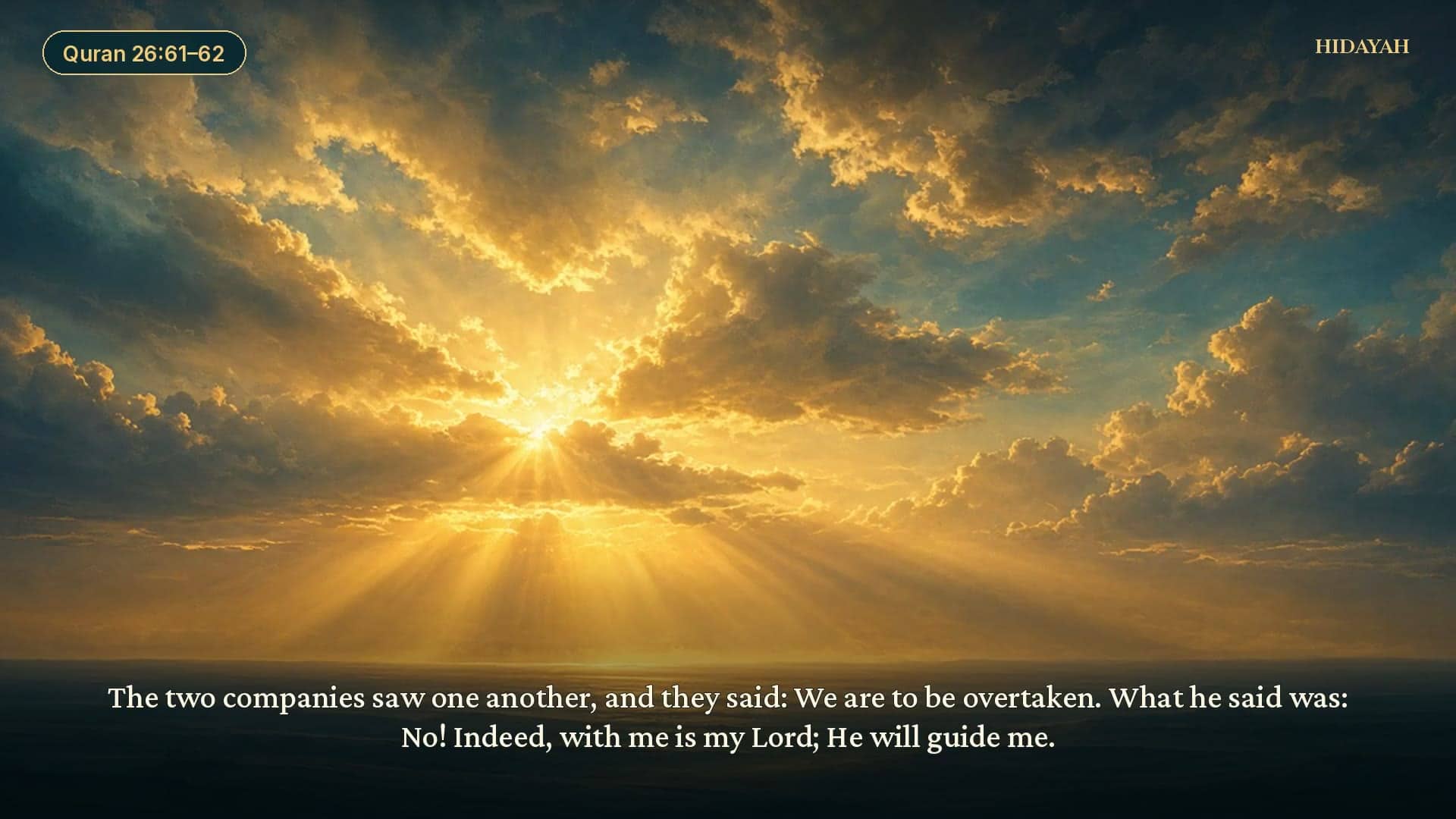
The two companies saw one another, and they said: We are to be overtaken. What he said was: No! Indeed, with me is my Lord; He will guide me. Follow the story of Prophet Musa (Moses), peace be upon him, in Episode 10: The Sea Parts.
This Quran-only episode follows Surah Ash-Shu'ara 26:52–68, Surah Taha 20:77–79 and Surah Yunus 10:90–92: the inspiration to travel by night with My servants, and the promise of a dry path through the sea; Pharaoh sending gatherers among the cities; the two companies seeing one another and the words No! Indeed, with me is my Lord; He will guide me; the command to strike the sea with the staff, and the sea parting with each portion like a great towering mountain; the saving of Moses and those with him; the drowning of the others; Pharaoh's words when drowning overtook him and the answer that follows; and the sign for those who succeed him. The Quran does not add names beyond those in the verses, and none are invented. Later events belong to other passages.
Every on-screen quotation is an exact excerpt of the Saheeh International translation with its verse reference. Arabic cards use Uthmani Quran text. Narration uses Musa; the translation writes Moses. Spoken quotations omit bracket notation and explanatory [i.e., ...] glosses, while captions preserve the source wording. No hadith, israiliyyat, invented names or invented conversations are used.
Chapters
0:00 The Sea Parts
0:18 Travel by Night
2:00 Indeed, We Are to Be Overtaken
Visuals and voices made with AI assistance.
#Hidayah #ProphetStories #IslamicStories #Quran10
 7:04Prophet Musa (AS) Story Ep 9 | Pharaoh and the Magicians
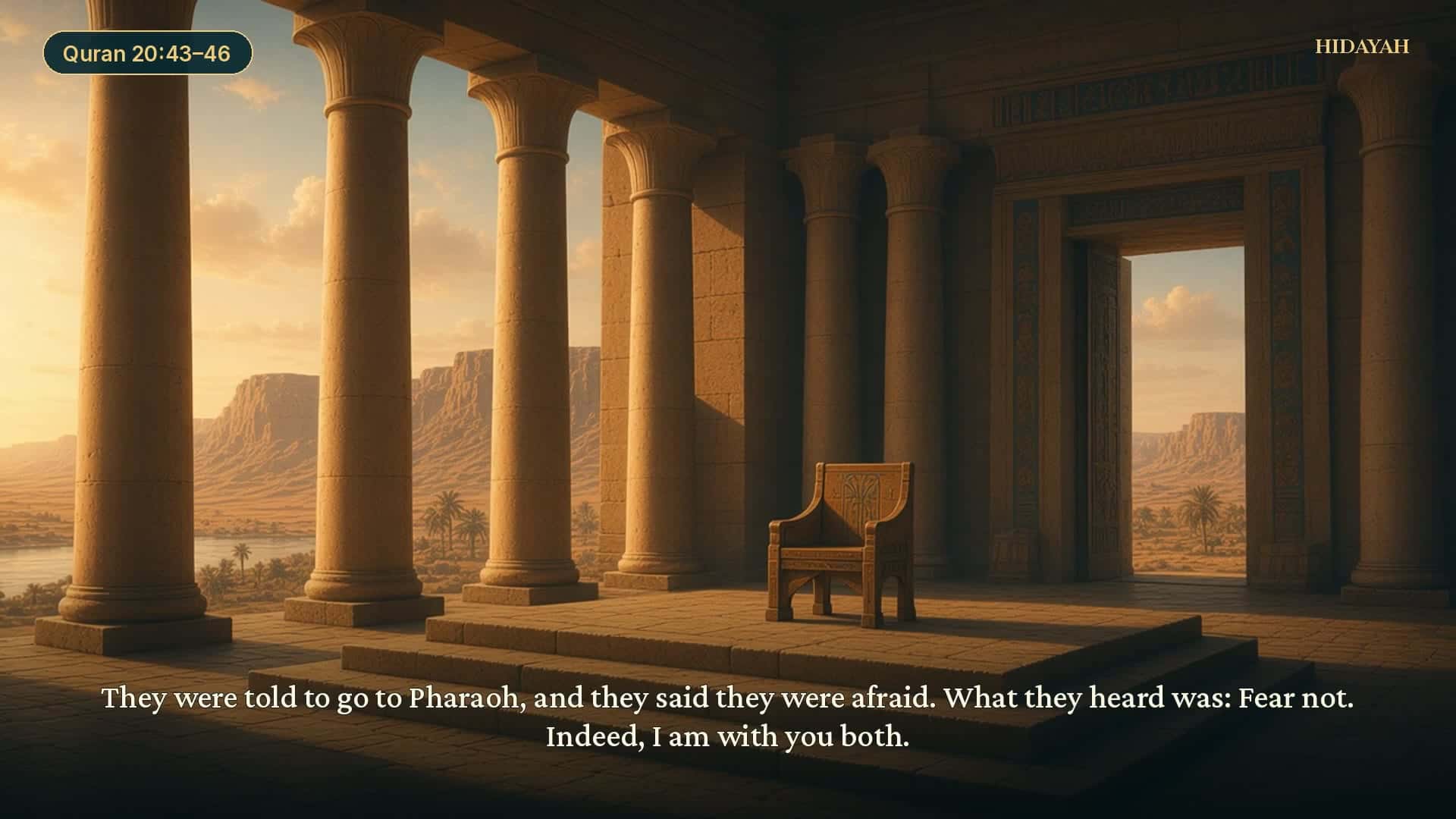
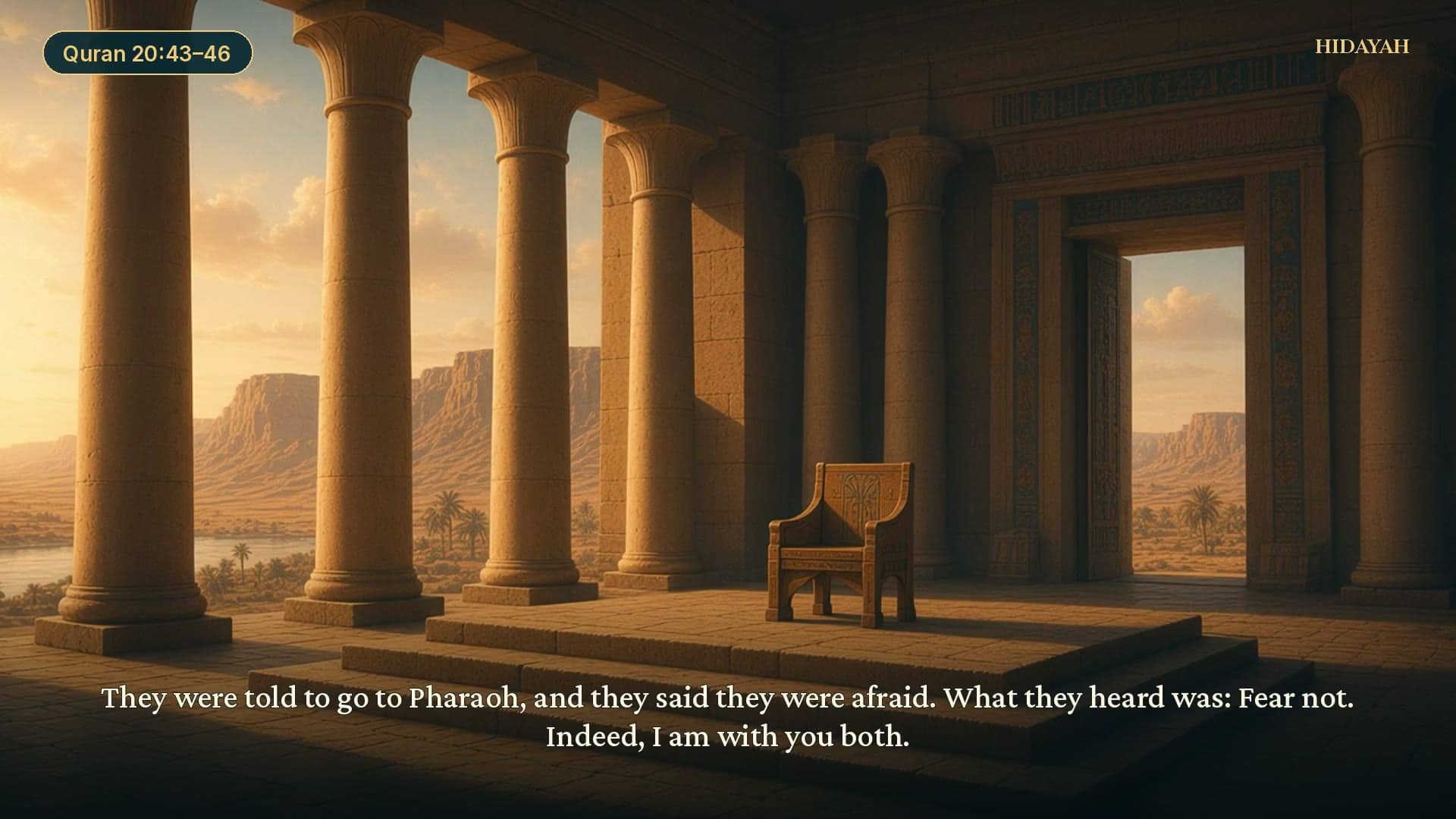
They were told to go to Pharaoh, and they said they were afraid. What they heard was: Fear not. Indeed, I am with you both. Follow the story of Prophet Musa (Moses), peace be upon him, in Episode 9: Facing Pharaoh and the Magicians.
This Quran-only episode follows Surah Taha 20:42–73 and Surah Ash-Shu'ara 26:10–51: the command to go, you and your brother, with gentle speech; their fear and the words Fear not, I am with you both, I hear and I see; the message to send with them the Children of Israel; Pharaoh's question about their Lord; the answer that He gave each thing its form and then guided it, and that He neither errs nor forgets; the signs shown, including the staff and the hand; the appointment on the day of the festival; the magicians who threw their ropes and staffs; the fear Musa sensed, the words Fear not, you are superior, and the staff that swallowed what they crafted; the magicians falling down in prostration, saying they had believed in the Lord of Aaron and Moses; and their reply when Pharaoh threatened them. The Quran does not add names beyond those in the verses, and none are invented. Later events belong to the next episodes.
Every on-screen quotation is an exact excerpt of the Saheeh International translation with its verse reference. Arabic cards use Uthmani Quran text. Narration uses Musa; the translation writes Moses and Aaron. Spoken quotations omit bracket notation and explanatory [i.e., ...] glosses, while captions preserve the source wording.
Visuals and voices made with AI assistance.
#Hidayah #ProphetStories #IslamicStories #Quran00
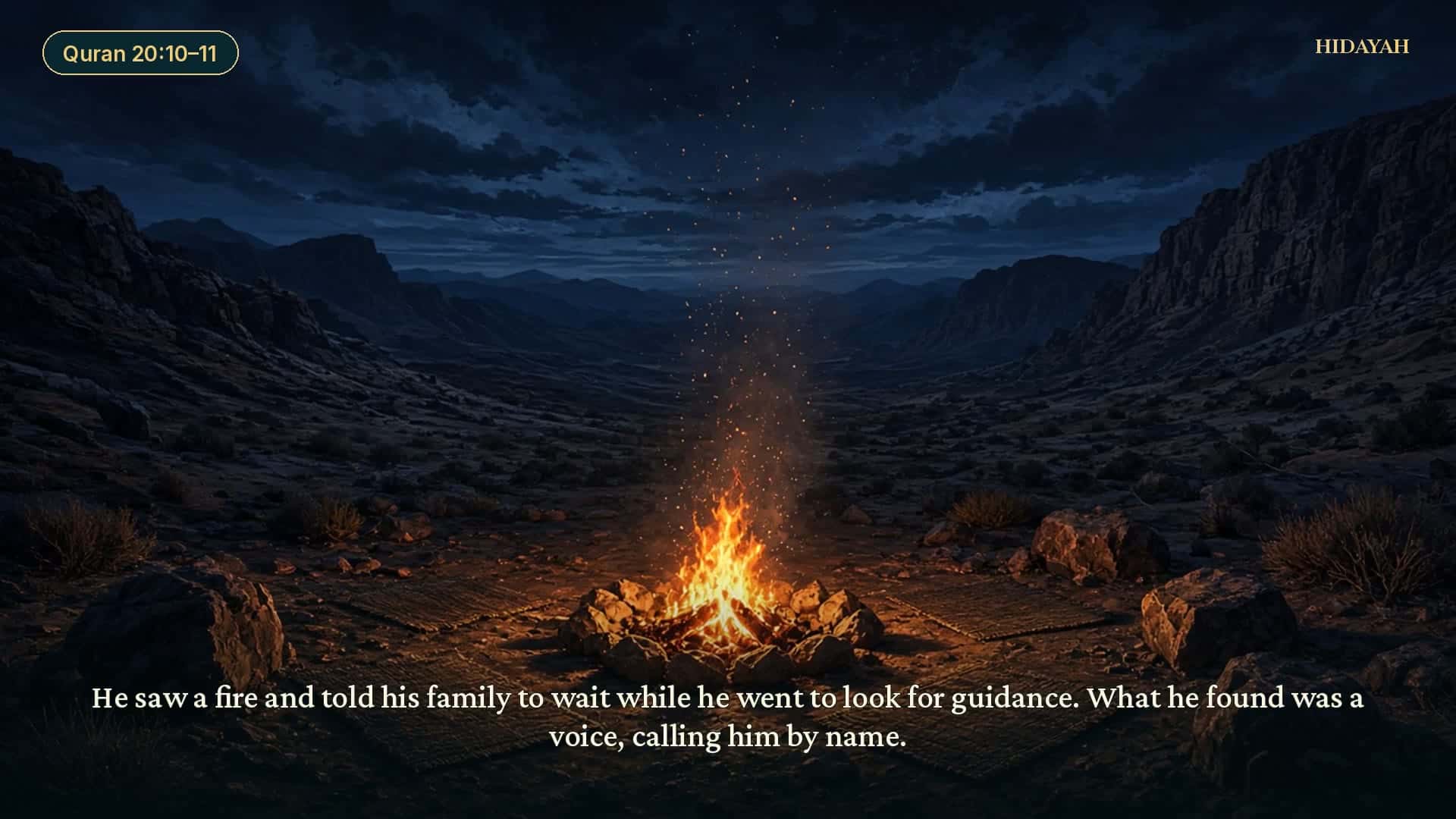
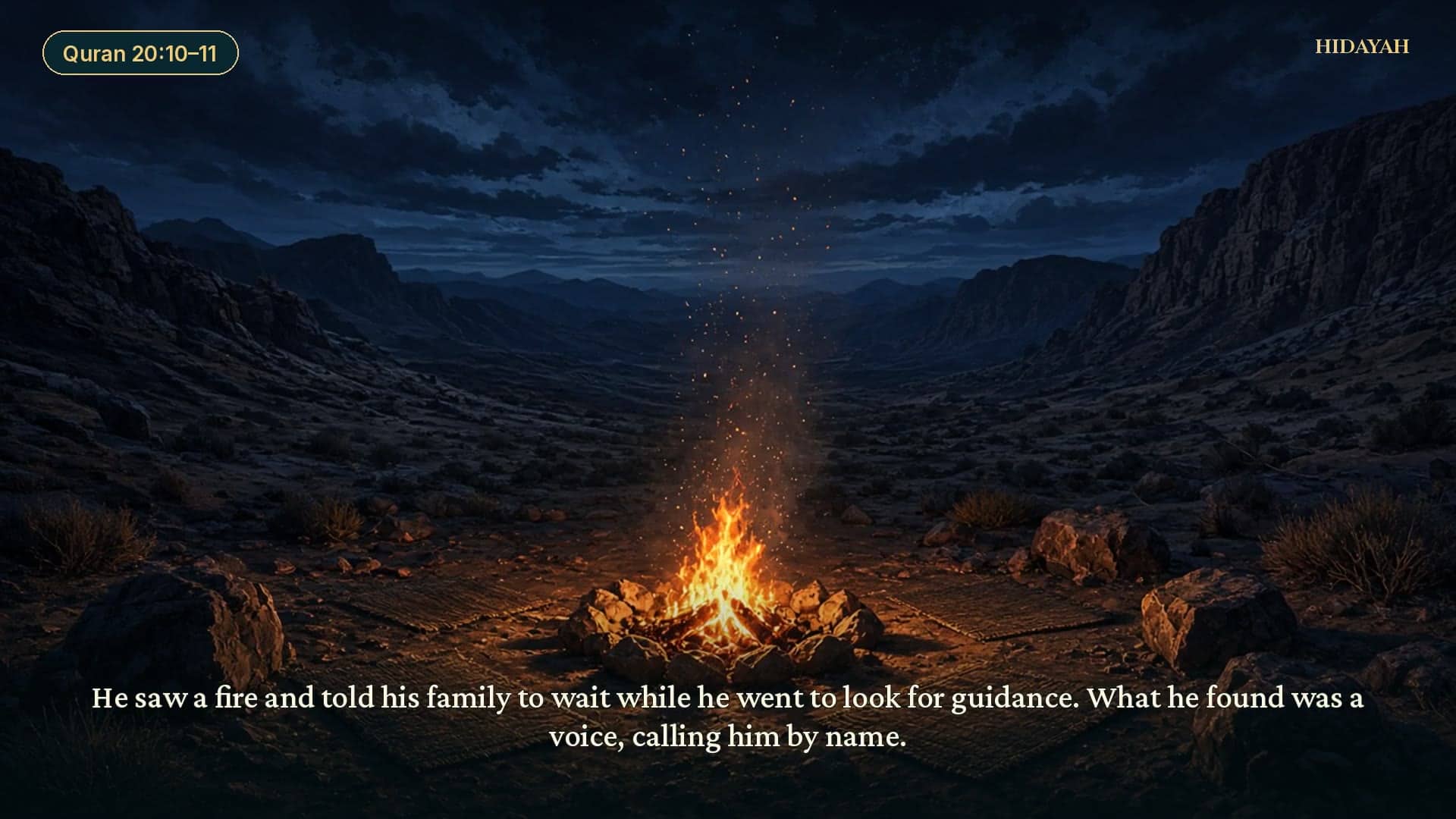 6:52Prophet Musa (AS) Story Ep 8 | The Fire on the Mountain
He saw a fire, told his family to wait, and went to look for guidance. What he found was a voice calling him by name. Follow the story of Prophet Musa (Moses), peace be upon him, in Episode 8: The Fire on the Mountain.
This Quran-only episode follows Surah Taha 20:9–36 and Surah Al-Qasas 28:29–35: the term completed and the journey with his family, the fire seen from the direction of the mount, the call to remove his sandals in the blessed valley, the declaration that there is no deity except Allah, the question about what was in his right hand, the staff that became a snake and the words fear not, the hand that came out white, the command to go to Pharaoh, Musa's prayer to expand his breast, ease his task, untie the knot from his tongue and appoint his brother Aaron, and the answer that his request was granted and his arm would be strengthened. The Quran does not add names beyond those in the verses, and none are invented. Later events belong to the next episodes.
Every on-screen quotation is an exact excerpt of the Saheeh International translation with its verse reference. Arabic cards use Uthmani Quran text. Narration uses Musa; the translation writes Moses and Aaron. Spoken quotations omit bracket notation and explanatory [i.e., ...] glosses, while captions preserve the source wording. No hadith, israiliyyat, invented names or invented conversations are used.
Chapters
0:00 The Fire on the Mountain
0:17 A Fire in the Distance
1:29 Remove Your Sandals
Visuals and voices made with AI assistance.
#Hidayah #ProphetStories #IslamicStories #Quran00
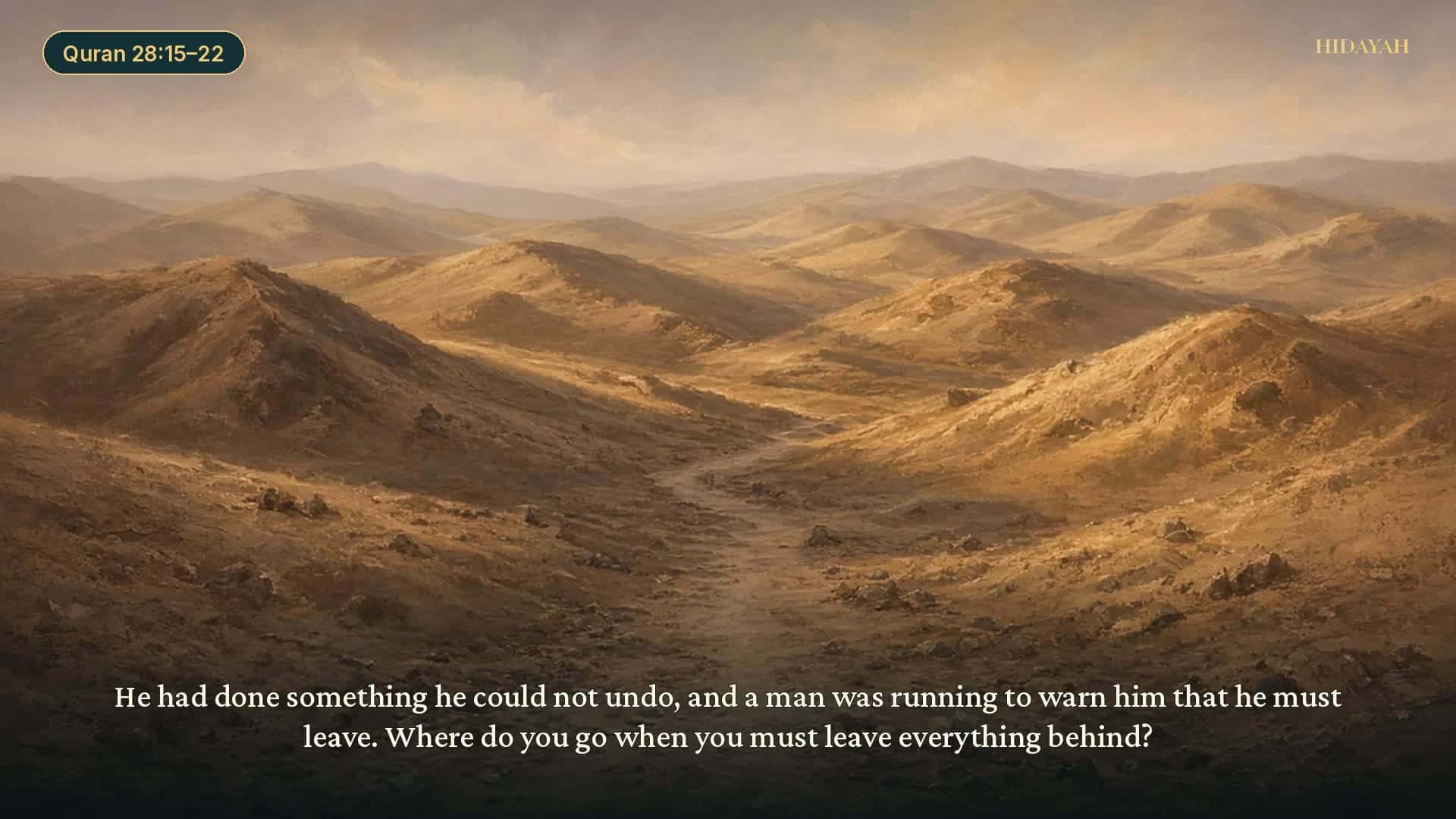
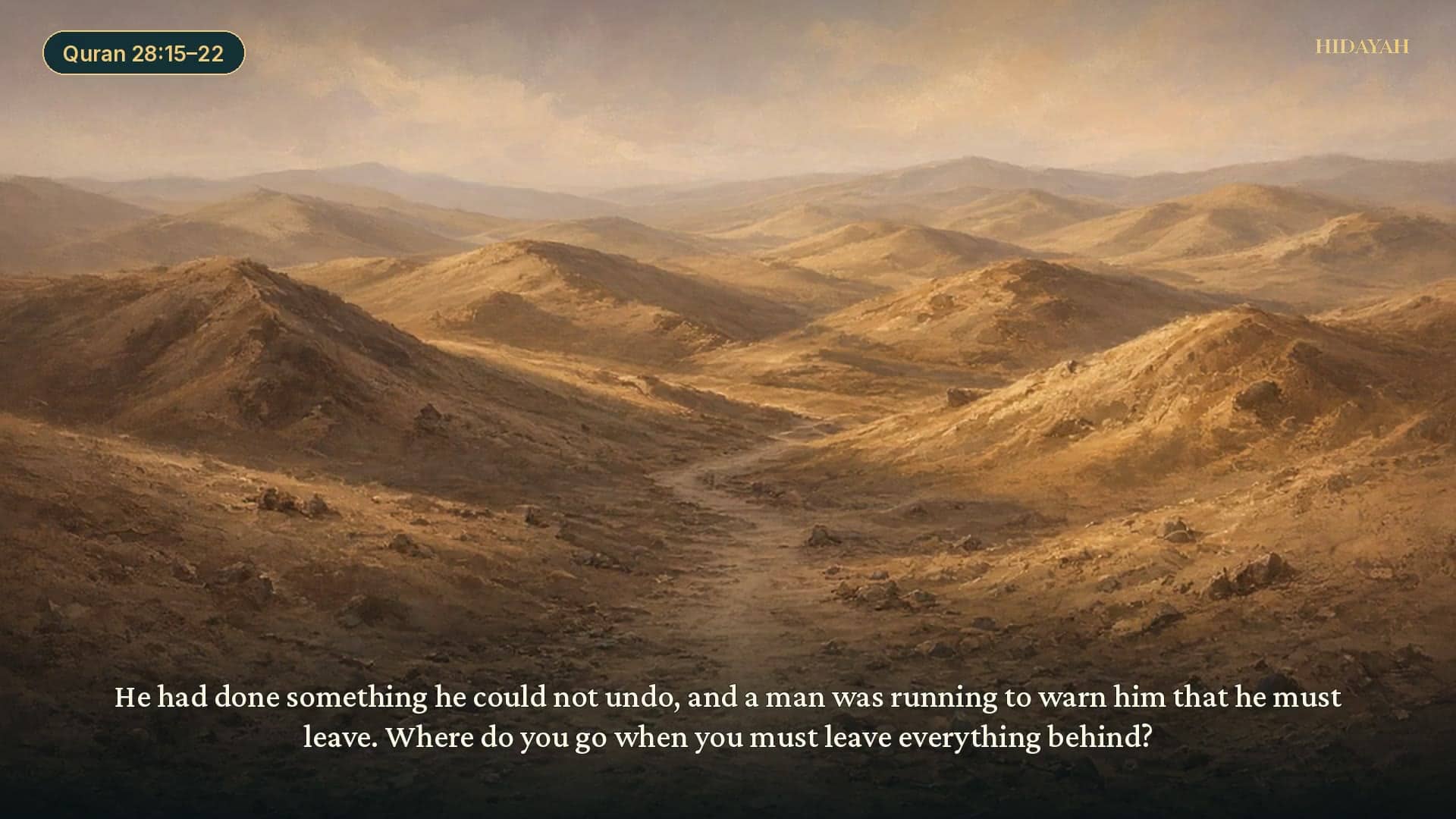 6:56Prophet Musa (AS) Story Ep 7 | Escape to Madyan
He did something he could not undo, and a man ran to warn him to leave. Follow the story of Prophet Musa (Moses), peace be upon him, in Episode 7: Escape to Madyan.
This Quran-only episode follows Surah Al-Qasas 28:14–28: Musa receiving judgement and knowledge, the day in the city, his prayer for forgiveness and the verse that says Allah forgave him, the second day, the man who came running to warn him, his flight and prayer to be guided toward Madyan, the two women at the water, his prayer of need, the invitation, the words that the best one to hire is the strong and the trustworthy, the offer of the father, and the agreement with Allah as Witness. The Quran does not name the two men, the man who ran, the two women or their father, so no names are added. Later events belong to the next episodes.
Every on-screen quotation is an exact excerpt of the Saheeh International translation with its verse reference. Arabic cards use Uthmani Quran text. Narration uses Musa; the translation writes Moses. Spoken quotations omit bracket notation and explanatory [i.e., ...] glosses, while captions preserve the source wording. No hadith, israiliyyat, invented names or invented conversations are used.
Chapters
0:00 Escape to Madyan
0:17 A Man in the City
1:29 My Lord, Forgive Me
2:38 Run From the City
3:20 The Water of Madyan
4:15 The Best One to Hire
5:12 Allah Is Witness
5:41 Reflections on the Verses
6:20 Sources & Next Episode
Sources
Visuals and voices made with AI assistance.
#Hidayah #ProphetStories #IslamicStories #Quran00
 6:43Prophet Musa (AS) Story Ep 6 | Born in the Shadow of Pharaoh
A tyrant slaughtering newborn sons. A mother inspired to cast her baby into the river. Begin the story of Prophet Musa (Moses), peace be upon him, in Episode 6: Born in the Shadow of Pharaoh.
This Quran-only episode follows Surah Al-Qasas 28:3–13 and Surah Taha 20:38–40, with 20:37 as context: Pharaoh's oppression, Allah's intention to favor the oppressed, the inspiration to the mother of Musa, the chest cast into the river, the family of Pharaoh picking him up, the words of Pharaoh's wife, a mother's empty heart, his sister following him, the wet nurses prevented, and the promise of Allah fulfilled as he was restored to his mother. The Quran does not name Musa's mother, sister or Pharaoh's wife, so no names are added. Only the first part of 20:40 is quoted; its later events belong to the next episodes.
Every on-screen quotation is an exact excerpt of the Saheeh International translation with its verse reference. Arabic cards use Uthmani Quran text. Narration uses Musa; the translation writes Moses. Spoken quotations omit bracket notation and explanatory [i.e., ...] glosses, while captions preserve the source wording. No hadith, israiliyyat, invented names or invented conversations are used.
Chapters
0:00 Born in the Shadow of Pharaoh
0:16 A Tyrant in the Land
1:30 Inspired to a Mother
2:31 Into the River
3:34 A Mother's Empty Heart
4:44 The Promise of Allah Is True
5:22 Reflections on the Verses
6:01 Sources & Next Episode
Sources
Visuals and voices made with AI assistance.
#Hidayah #ProphetStories #IslamicStories #Quran00
 6:29Prophet Yusuf (AS) Story Ep 5 | The Dream Comes True
A father's grief. A brother's forgiveness. A dream made real. Complete the story of Prophet Yusuf (Joseph), peace be upon him, in Episode 5: The Dream Comes True.
The Yusuf series finale follows selected passages and cited paraphrase from Surah Yusuf 12:83–111: Yaqub's patience and hope, Yusuf revealing himself, forgiveness, the shirt and the return of Yaqub's sight, the family entering Egypt, the dream fulfilled in 12:100, Yusuf's prayer in 12:101, and the surah's closing reminders. The earlier dream is revisited from 12:4. Verse 12:87 is quoted using the exact Saheeh International wording “despair not of relief from Allāh,” rather than substituting a popular paraphrase about mercy.
Every on-screen quotation is an exact excerpt of the Saheeh International translation with its verse reference. Arabic cards use Uthmani Quran text. Narration uses Yusuf and Yaqub; the translation writes Joseph and Jacob. Spoken quotations omit bracket notation and explanatory [i.e., ...] glosses, while captions preserve the source wording. No hadith, israiliyyat, invented names or invented conversations are used.
Chapters
0:00 The Dream Comes True
0:16 Patience in Grief
1:21 I Am Joseph
2:13 The Shirt and Good Tidings
2:57 The Dream Becomes Reality
4:02 Guidance and Mercy
5:14 Reflections on the Verses
5:54 Sources & Series Finale
Sources
About this video: the images are AI-generated illustrative environments, not documentary reconstructions, and show no prophet or person.
#Hidayah #ProphetStories #IslamicStories #Quran00
 6:14Prophet Yusuf (AS) Story Ep 4 | The Brothers Return
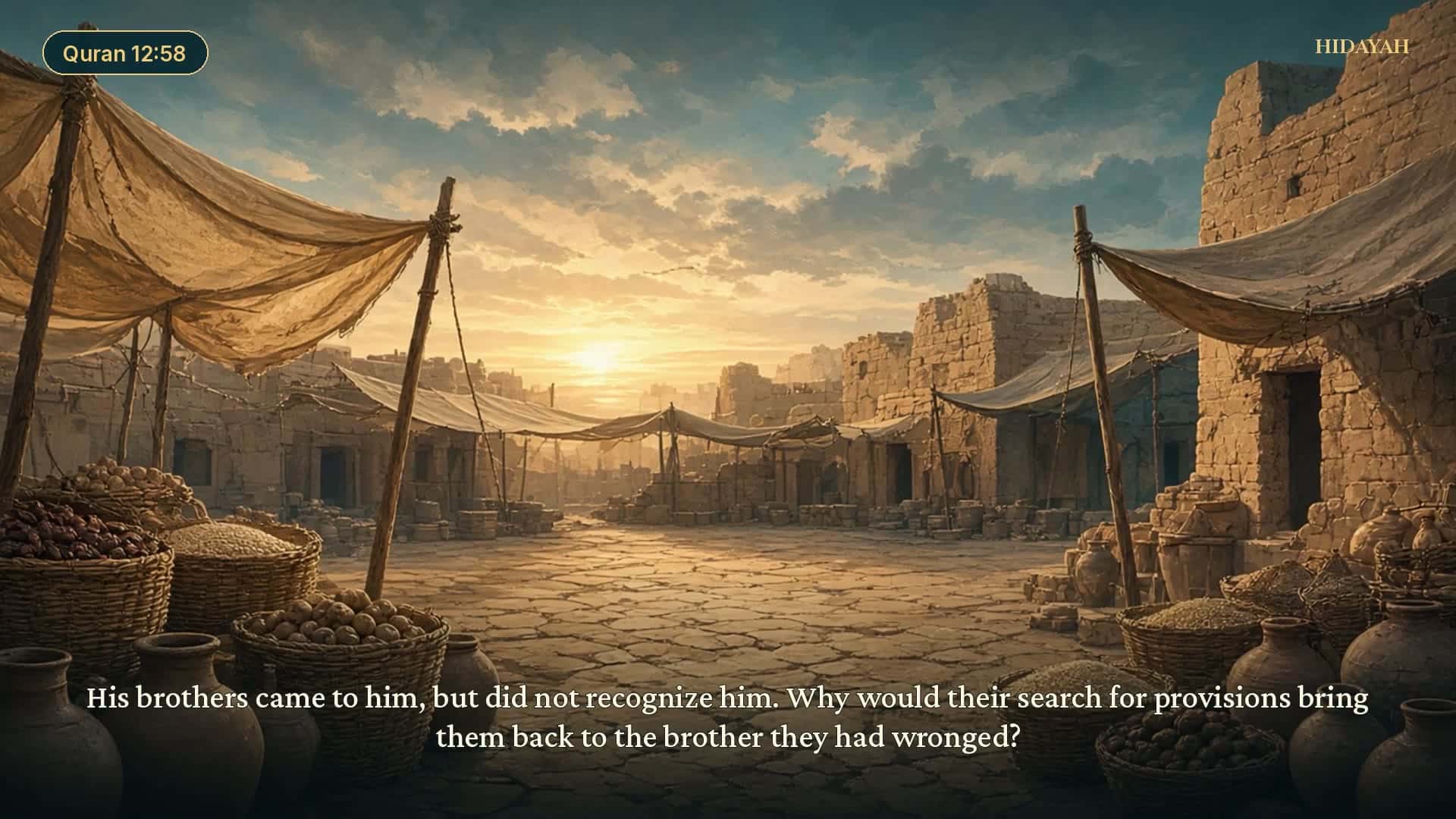
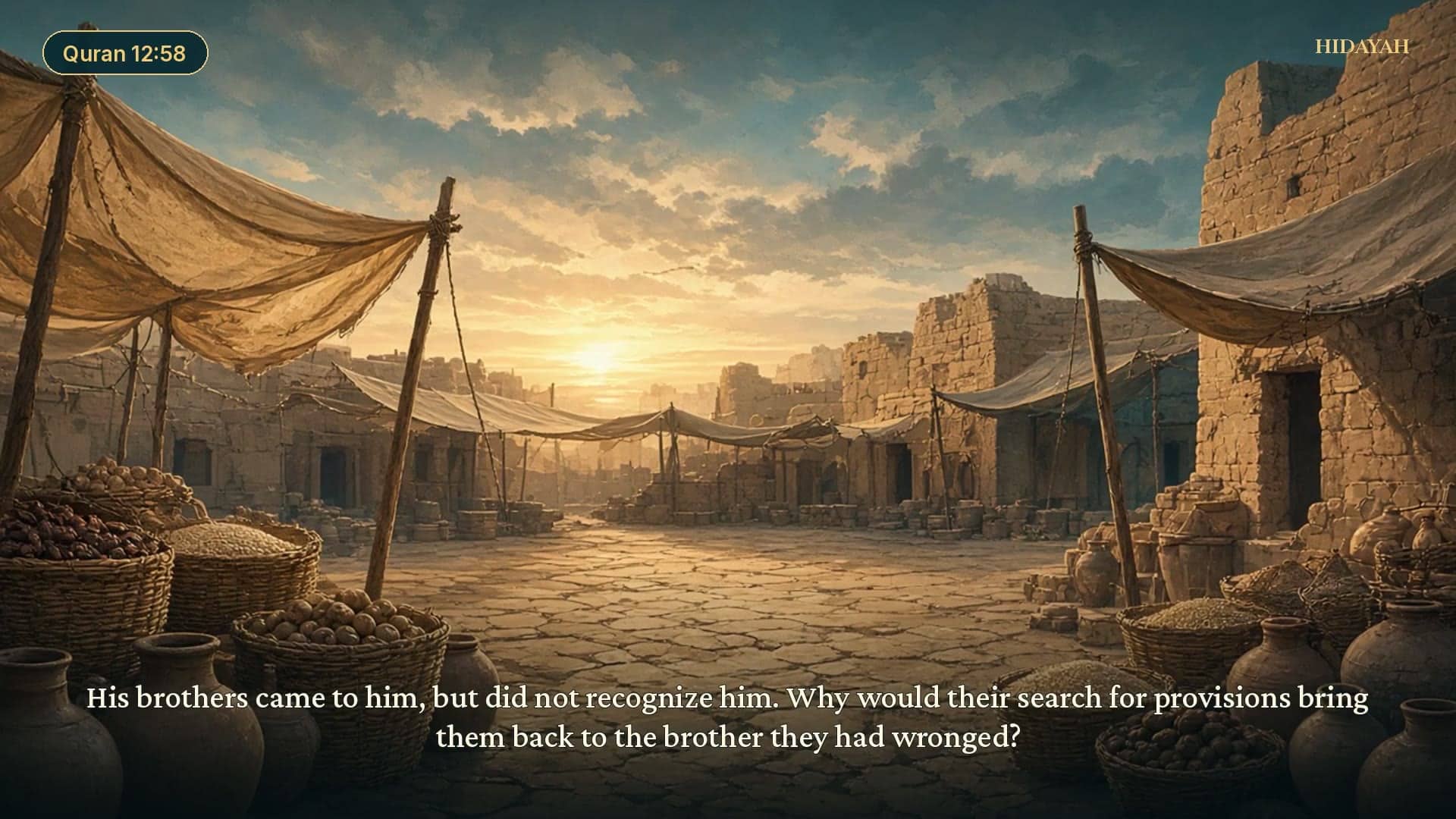
His brothers came seeking provisions, but did not recognize him. Continue the story of Prophet Yusuf (Joseph), peace be upon him, in Episode 4: The Brothers Return.
This Quran-only episode follows Surah Yusuf 12:58–82: the request to bring their brother, Yaqub's concern and the oath, entering through different gates, Yusuf revealing himself to his brother, the measuring bowl, the brothers' plea and the eldest remaining behind. The theft accusations are presented as reported statements, not as established wrongdoing by Yusuf or his brother. No unsupported explanation for the different gates is added.
Every on-screen quotation is an exact excerpt of the Saheeh International translation with its verse reference. Arabic cards use Uthmani Quran text. Narration uses Yusuf and Yaqub; the translation writes Joseph and Jacob. Spoken quotations omit bracket notation and explanatory [i.e., ...] glosses, while captions preserve the source wording. No hadith, israiliyyat, invented names or invented conversations are used.
Chapters
0:00 The Brothers Return
0:14 They Did Not Recognize Him
1:18 A Father Asked to Trust Again
2:08 Different Gates, One Reliance
2:52 The Measuring Bowl
4:03 The Plea and the Eldest Brother
5:02 Reflections on the Verses
5:37 Sources & Next Episode
Sources
About this video: the images are AI-generated illustrative environments, not documentary reconstructions, and show no prophet or person. The narration is an AI voice.
#Hidayah #ProphetStories #IslamicStories #Quran00
 6:42Prophet Yusuf (AS) Story Ep 3 | From Prison to Minister
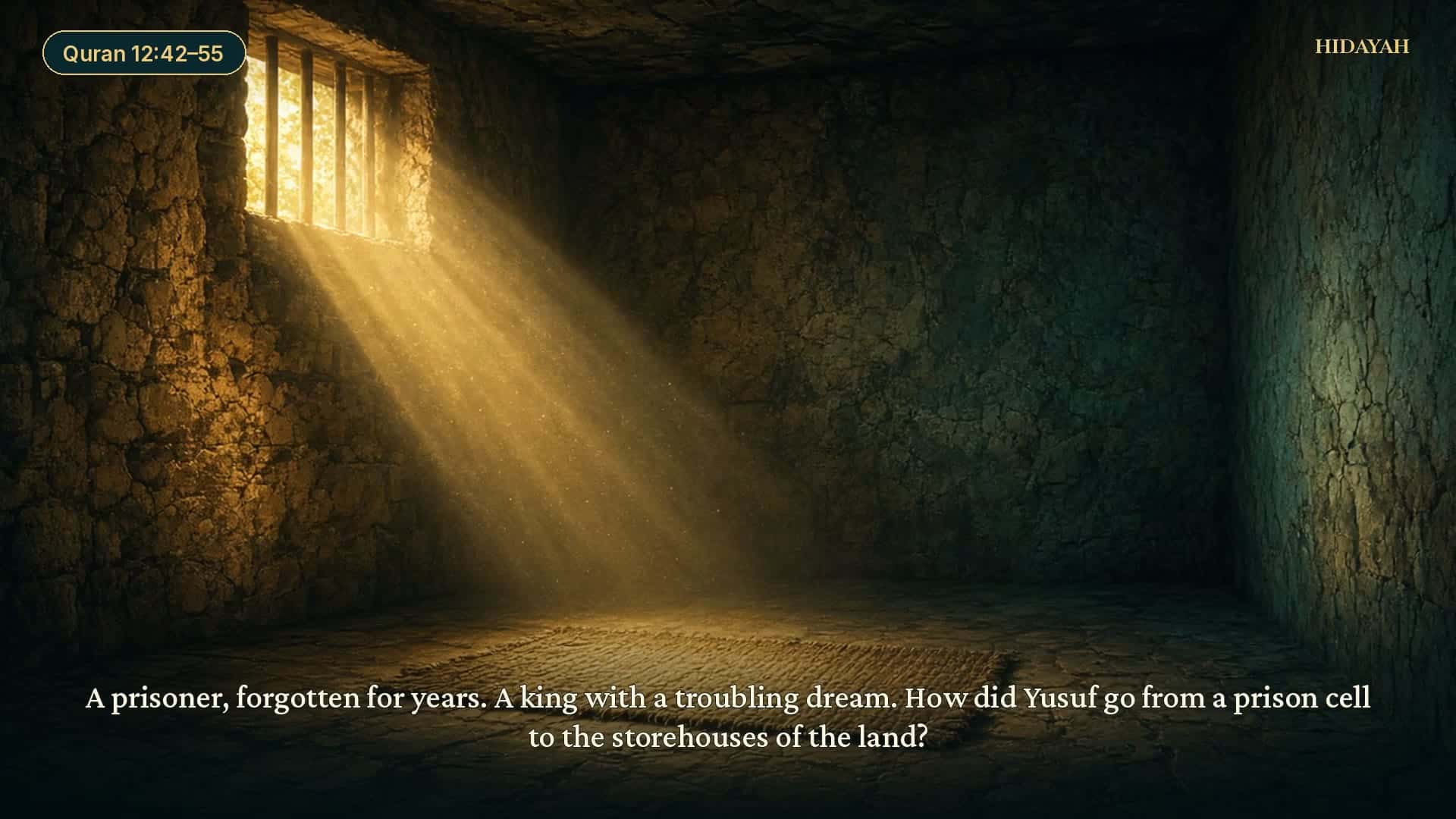
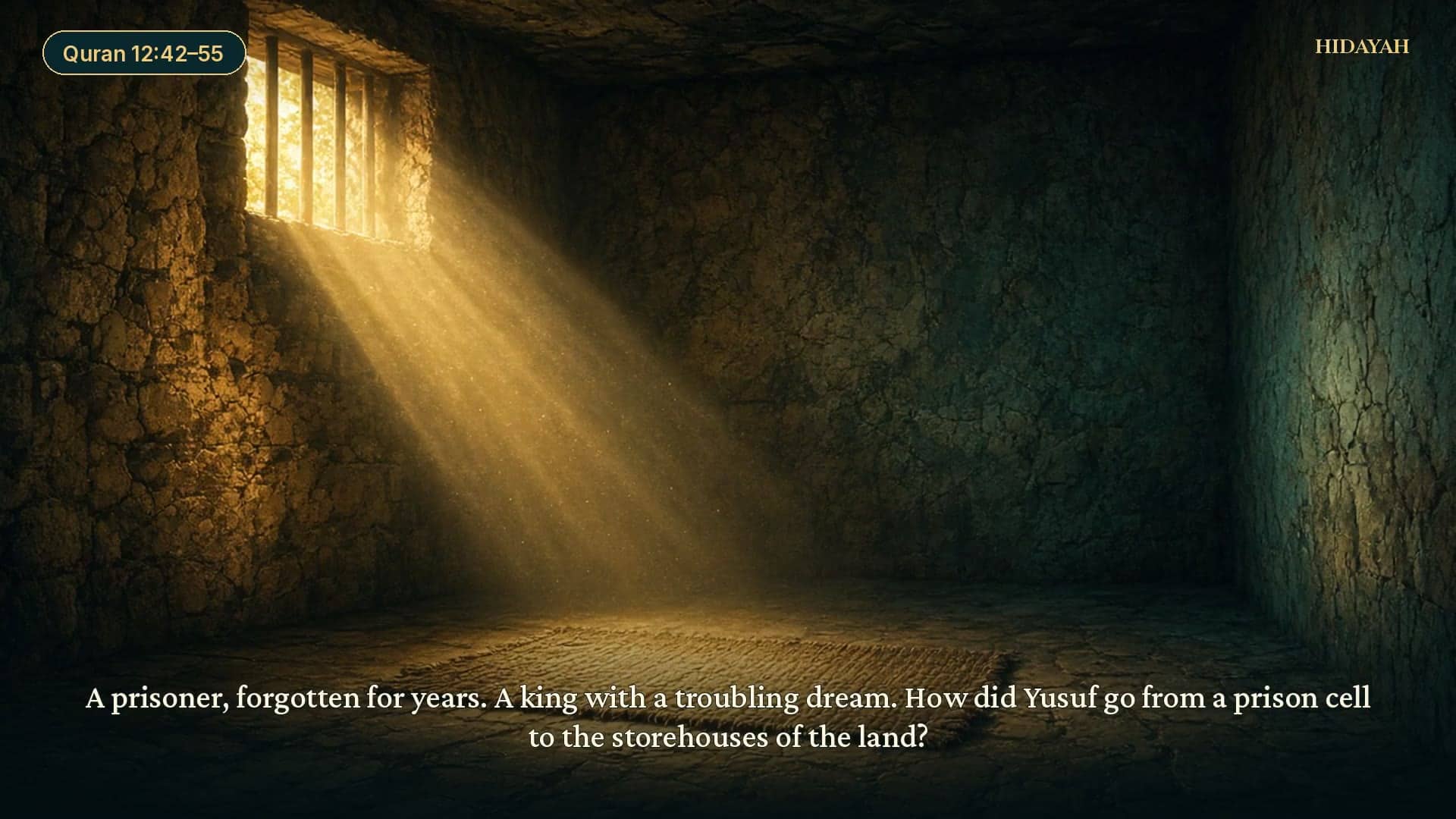
A forgotten prisoner. A king's dream. Seven years of harvest, followed by seven difficult years. Discover how Prophet Yusuf (Joseph), peace be upon him, went from a prison cell to responsibility over the storehouses of the land.
Episode 3 of Hidayah's Stories of the Prophets continues directly from He Chose Prison. It follows only the Quran, Surah Yusuf 12:36–57: the two prisoners' dreams, the king's dream, Yusuf's interpretation and preparations, the inquiry that reveals his innocence, and his establishment in the land.
Every on-screen quotation is an exact excerpt of the Saheeh International translation with its verse reference. Arabic cards use the Uthmani Quran text. Narration uses Yusuf; the translation writes Joseph. Spoken quotations omit bracket notation and the translator's explanatory [i.e., ...] glosses, while captions preserve the source wording. No hadith, israiliyyat, invented conversations or invented names are used. The king and the wife of al-Aziz remain unnamed. Verses 12:52–53 are presented in sequence without adding a disputed speaker attribution.
Chapters
0:00 From Prison Cell to Minister
0:16 Two Companions of Prison
1:56 The King's Dream
2:49 Seven Years, Then Seven
3:28 Truth Before Freedom
4:37 Trusted with the Storehouses
5:20 Reflections on the Verses
6:06 Sources & Next Episode
Source
About this video: the images are AI-generated illustrative environments, not documentary reconstructions, and show no prophet or person.
#Hidayah #ProphetStories #IslamicStories #Quran00
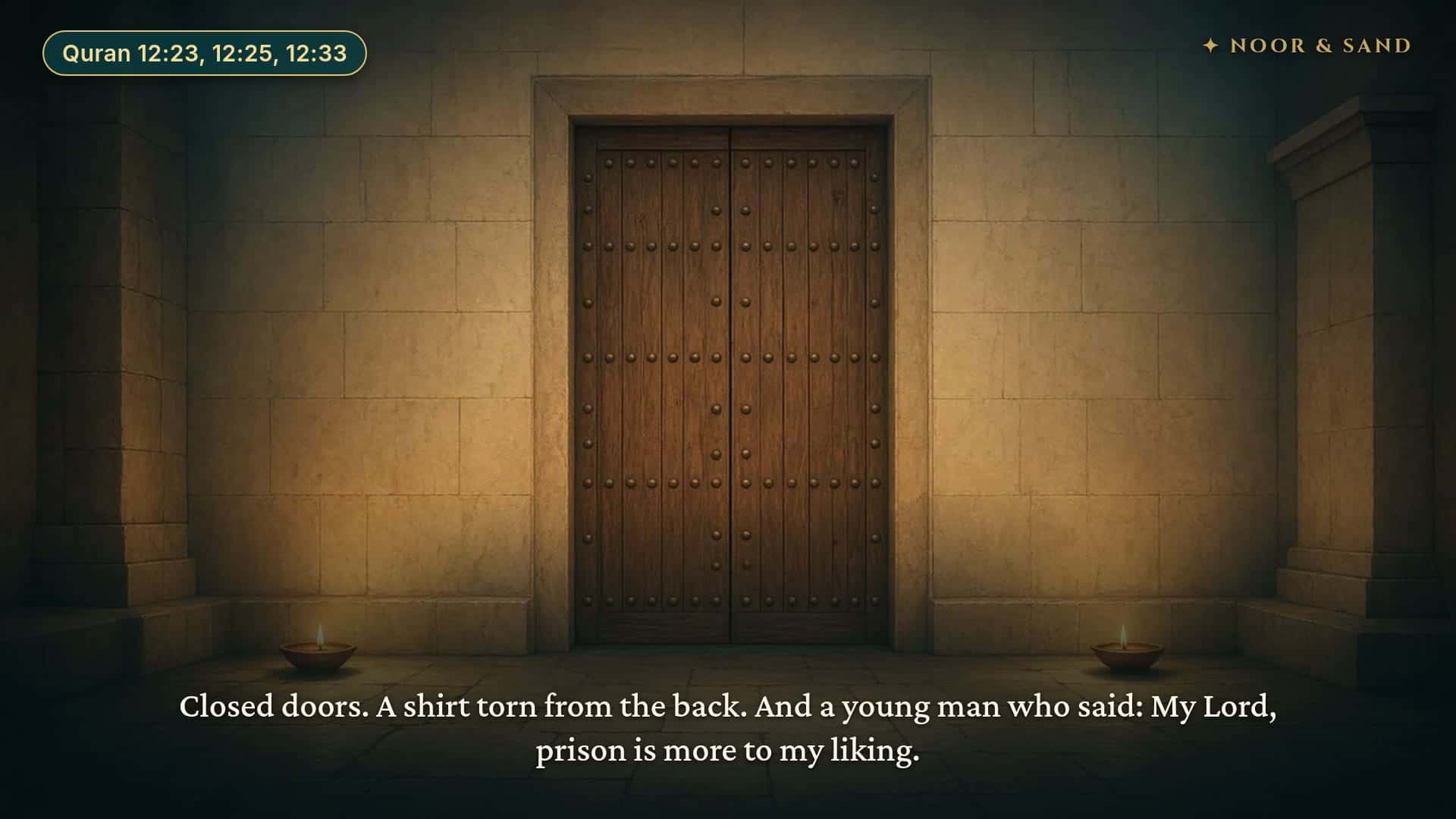
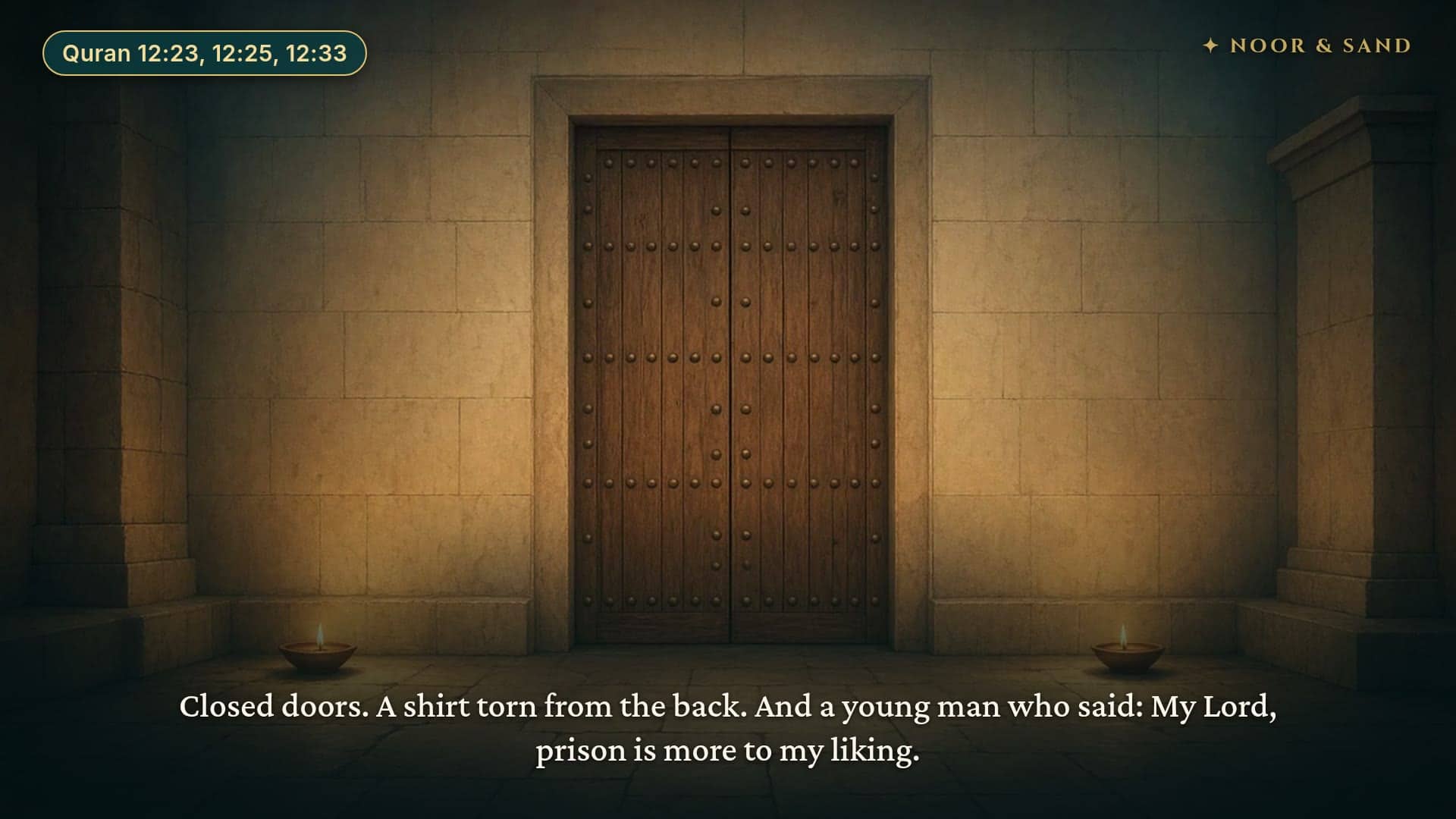 6:23Prophet Yusuf (AS) Story Ep 2 | He Chose Prison
Closed doors. A shirt torn from the back. A young man who chose prison over wrongdoing. Continue the story of Prophet Yusuf (Joseph), peace be upon him, in Episode 2 of Hidayah's Stories of the Prophets.
Told only from the Quran, Surah Yusuf 12:22–35. Every quotation on screen follows the exact Saheeh International translation and carries its reference. Narration uses Arabic names; the translation writes Joseph. The Quran does not name the wife of al-Aziz, and neither do we. No hadith or israiliyyat are used in this episode.
Chapters
0:00 Judgement and Knowledge
1:07 The Refuge of Allah
1:47 The Torn Shirt
2:44 The Women of the City
3:38 Prison Is More to My Liking
4:16 Lessons from the Story
5:51 Sources & Next Episode
Sources
About this video: the images are AI-generated and show no prophet and no person. The narration is an AI voice. Lessons are marked on screen as reflections on the verses; they are not quotations. This episode was originally produced under the name Noor & Sand; the channel is now Hidayah.
If you notice a mistake, please tell us so we can correct it.
#Hidayah #ProphetStories #IslamicStories #Quran10
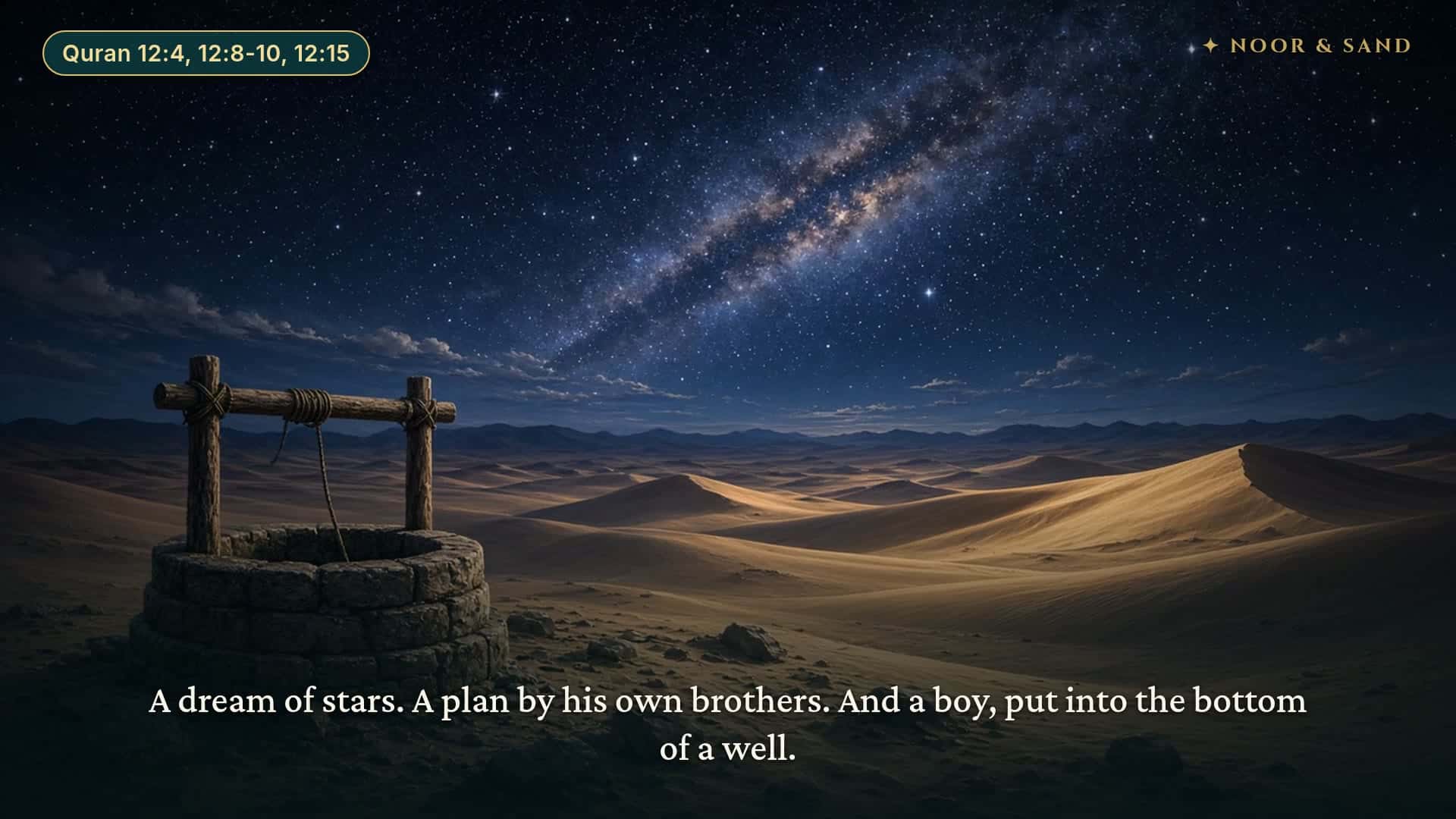
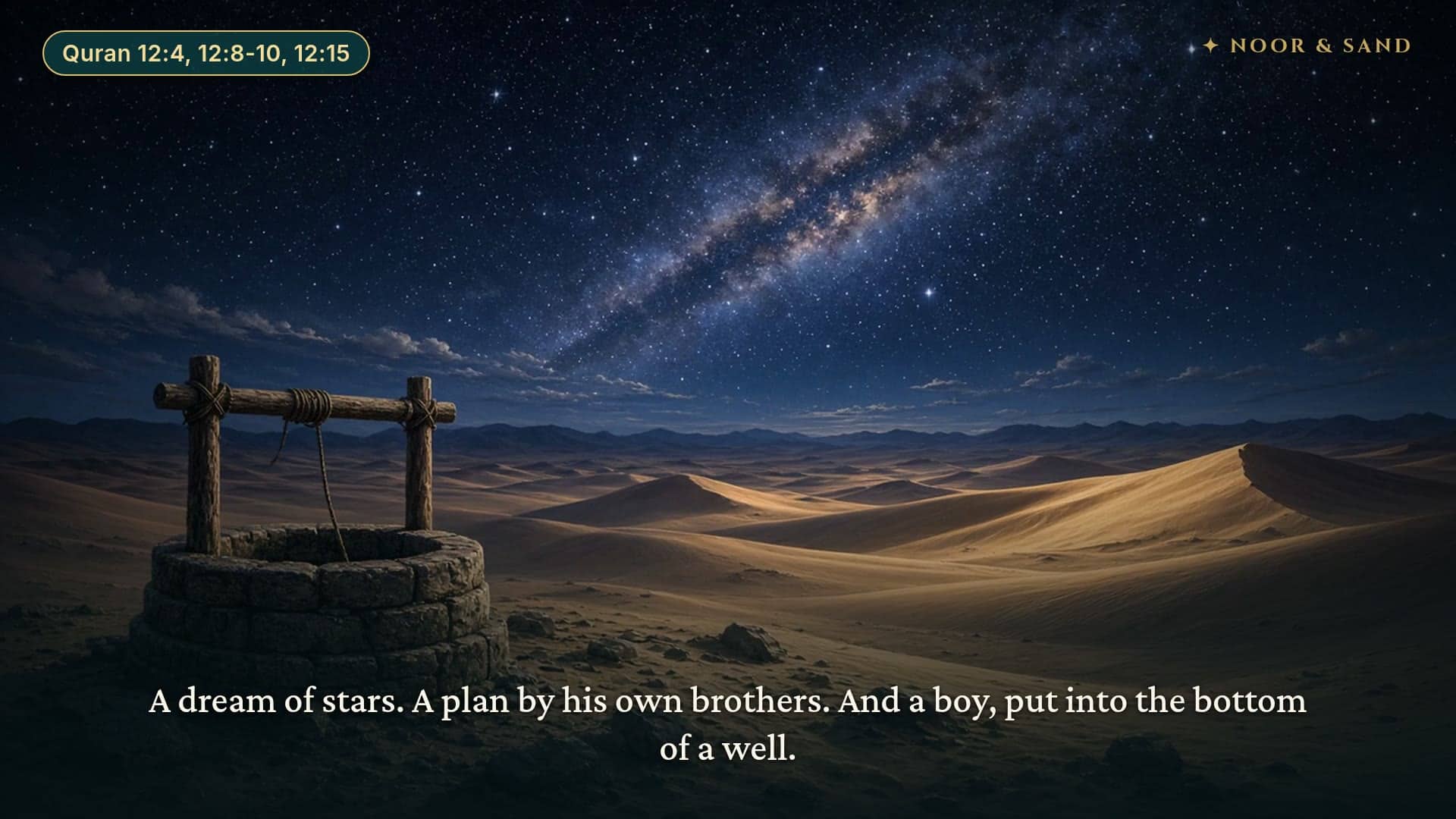 6:57Prophet Yusuf (AS) Story Ep 1 | The Boy in the Well
A dream of eleven stars. A betrayal by his brothers. A boy at the bottom of a well. Begin the story of Prophet Yusuf (Joseph), peace be upon him, in Episode 1 of Hidayah's Stories of the Prophets.
This episode follows Surah Yusuf 12:1–21, with supporting authentic hadith from Sahih al-Bukhari. Quran quotations follow the Saheeh International translation. Narration uses Arabic names such as Yusuf and Yaqub where the translation writes Joseph and Jacob. References appear on screen.
Chapters
0:00 The Best of Stories
0:52 The Dream
1:42 The Brothers' Plan
2:24 Send Him With Us
2:59 The Well
3:18 The Shirt and the False Blood
3:51 The Caravan
4:28 Lessons from the Story
5:29 Sources & Next Episode
Sources
About this video: the images are AI-generated illustrations, and the narration is an AI voice. No prophet is depicted. Reflections are commentary, not scripture. This episode was originally produced under the name Noor & Sand; the channel is now Hidayah.
If you notice a mistake, please tell us so we can correct it.
#Hidayah #ProphetStories #IslamicStories #Quran00